
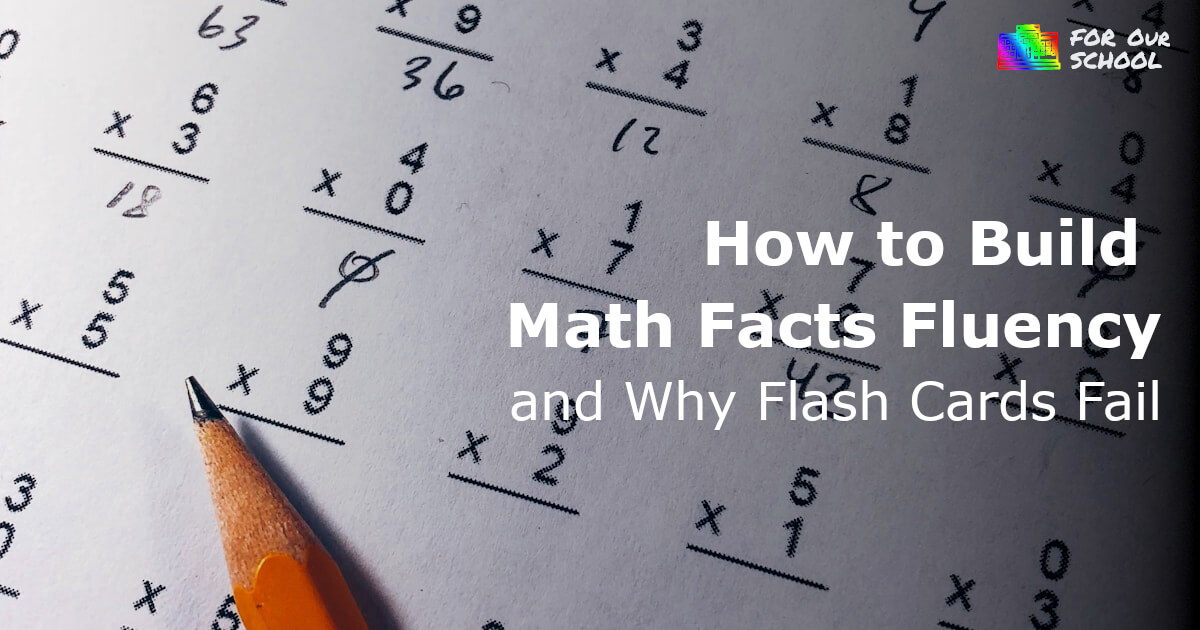
Math facts are basic addition, subtraction, multiplication, and division operations involving two numbers. These are usually single digit numbers, though they can extend up to twenty. Students are expected to recall these facts quickly and accurately, without counting or relying on other calculations.
Almost every type of math problem relies on fast recall of basic math facts, including reducing fractions, calculating area or volume, solving multi step word problems, and even telling time on an analog clock. When students struggle with recall, they spend time and mental energy on simple calculations instead of focusing on the actual problem they are trying to solve.
Strong math facts fluency removes that friction. When basic operations are automatic, students move through problem sets and exams faster, make fewer errors, and have more mental space to understand new concepts. Conversely, the longer a student delays learning their math facts, the more likely they are to fall behind. It is not an exaggeration to say that building math facts fluency early can be one of the biggest differentiators between students who excel in math and those who struggle.
Flash cards and worksheets: why traditional approaches fall short
Despite the importance of math facts fluency, the way students are typically taught to practice them has not changed much in decades. This usually involves flash cards, where the problem is written on one side and the answer on the other, or worksheets that display a random assortment of problems for a particular operation. In both cases, the goal is speed and accuracy, so parents and teachers often use timers and encourage students to solve each problem in roughly two to three seconds.
Limitations of flash cards
Flash cards often fail because they provide very little insight into how a student is improving. Common issues include:
-
No visibility into weak facts
Students cycle through all cards, even the ones they already know well, instead of focusing on the facts that slow them down. -
No progress tracking over time
Accuracy and time per problem can be observed during a single session, but there is no built in way to record results and compare sessions. -
False confidence from familiarity
Students may recognize cards they have seen repeatedly without having truly mastered recall in new or mixed contexts.
Without a system to record and analyze results, it becomes difficult to answer basic questions like:
- Which facts are actually mastered?
- Which facts are improving?
- Which facts continue to cause delays?
Limitations of worksheets
Worksheets introduce a different set of problems and can sometimes be even more misleading. Common issues include:
-
Pattern recognition instead of recall
Unless many worksheets are used with different randomizations, students may associate answers with the position of a problem on the page rather than the math fact itself. -
Illusion of progress
Students may perform well on a familiar worksheet, then struggle when the same facts appear in a different order or context. -
Broad practice instead of targeted practice
Like flash cards, worksheets often require students to repeatedly practice facts they already know instead of focusing on the ones they miss.
In both cases, students can appear to be making progress while still struggling with the same underlying facts.
Free Math Facts Practice
ForOurSchool.org offers free math facts practice with timers, charts, and tracked results to help students build speed and confidence. Along with our Math-A-Thon platform, guides, and games, it supports strong math skills beyond the classroom.
What effective math facts practice actually requires
To build real math facts fluency, practice needs more than repetition. It needs structure, feedback, and focus. Effective math facts practice should include:
-
Tracking accuracy and time per problem
The two most important metrics. -
Saved results across sessions
Necessary to compare performance over time. -
Clear identification of weak facts
Helps students know where they need the most work. -
Targeted practice
Practice time should be spent on the facts a student struggles with, not the ones they already know. -
Visual feedback
Charts and summaries help students understand their progress and stay motivated.
Math facts fluency is not about grinding through more flash cards or filling out more worksheets. It is about intentional practice, clear feedback, and consistent tracking over time. When students practice with the right structure in place, progress becomes easier to see and easier to sustain.
Make Fundraising Fun and Educational


Leave a Reply
You must be logged in to post a comment.